Setting Proper pH Levels
Maintaining the ideal growing environment is an ongoing process. Beyond lighting, airflow, and climate, plants also need access to the nutrients within their growing system, and maintaining the proper pH plays an important role in that process.
Understanding what pH measures, how to monitor it, and how to make careful adjustments can help growers maintain more consistent conditions in hydroponic and other growing systems.
- The pH scale runs from 0 to 14.
- A pH of 7 is considered neutral.
- Values below 7 are acidic, while values above 7 are alkaline.
- For hydroponic growing, the source recommends maintaining pH between 5.5 and 6.5.
- Test strips, liquid test kits, and digital meters can all be used to monitor pH.
- Digital pH meters provide fast, precise readings.
- Make gradual adjustments rather than changing pH too rapidly.
What Is pH?
A solution's pH level describes its acidity or alkalinity. These levels are measured on a scale from 0 to 14, with 0 representing the most acidic end of the scale, 14 representing the most alkaline, and 7 representing pH neutral.
Lower pH
Pure water reference
Higher pH
pH in Hydroponic Growing
When growing plants and vegetables hydroponically, the source recommends maintaining a pH level between 5.5 and 6.5.
A more acidic environment can cause toxicity and inhibit plant growth, while excessive alkalinity can make nutrients less soluble and also interfere with growth.
Can contribute to toxicity and inhibit plant growth.
Can reduce nutrient solubility and interfere with growth.
Potential deficiencies may appear as paler or cupped leaves and can contribute to a yellowed appearance.
How to Monitor pH Levels
There are several practical ways to measure the pH of your growing solution, ranging from simple color-based tests to digital meters.
Test Strips
Dip the strip into your solution and compare the resulting color with the accompanying chart.
Easy and inexpensive, but not necessarily the most accurate.Liquid Test Kits
Add a liquid testing solution to your sample, then compare the resulting color with a reference chart.
Offers greater reliability while remaining relatively simple.Digital pH Meters
Use a sensor probe and digital display to quickly calculate the characteristics of your solution.
Designed for fast and precise readings.Using a Digital pH Meter
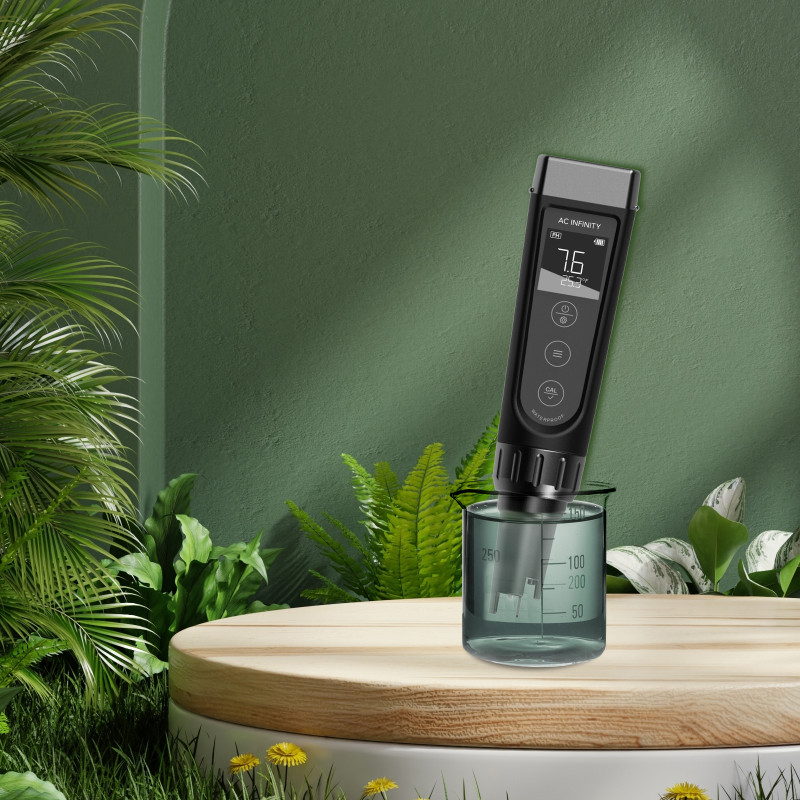
For growers looking for more precise readings, digital pH meters provide a fast way to monitor water quality.
AC Infinity offers standard and advanced meters that calculate the acidity, alkalinity, and temperature of a solution.
All-in-one meters can provide additional measurements, including salinity, conductivity, and EC.
pH Meter Kit
A digital pH pen for monitoring water quality and temperature.
Explore pH Meter Kit →pH Meter PRO Kit
An advanced meter option with an interchangeable probe.
Explore pH Meter PRO →Hydroponic Meter PRO
Provides pH measurements alongside salinity, conductivity, EC, and additional water-quality data.
Explore Hydroponic Meter PRO →Maintain Your Meter
Accurate measurements also depend on maintaining your meter properly. The source recommends monthly calibration and secure storage conditions.
Failing to properly calibrate or store the meter may jeopardize the accuracy of future readings.
- Calibrate the meter monthly.
- Store the meter securely between uses.
- Monitor readings for consistency.
- Increase testing frequency when conditions are unstable.
How Often Should You Test pH?
Testing frequency can vary depending on your experience and how stable the growing system has become.
Daily measurements may be safest while learning the system and determining how much pH fluctuates.
Once readings remain consistently stable, weekly testing may be sufficient.
Adjusting pH Levels
Once you're regularly testing water quality, pH adjusters can be used when the solution moves outside the desired range.
There are many acids and alkalis available for adjusting pH, including products designed specifically for gardening. Because these solutions vary in potency and can cause side effects, research the product beforehand and follow all safety instructions.
Make Small Adjustments
Start with minor changes when modifying pH. Adjusting levels too rapidly or too frequently may shock the plant's system.
- Measure first. Determine the current pH before making any changes.
- Identify the needed direction. Determine whether the solution needs to become more acidic or more alkaline.
- Follow the adjuster's instructions. Different products vary in potency and required precautions.
- Make a minor adjustment. Avoid making large changes all at once.
- Continue monitoring. Test the solution regularly to determine whether additional adjustment is necessary.
Make pH Part of Your Growing Routine
Maintaining proper pH is an important part of creating a stable growing environment because it affects the conditions surrounding nutrient availability and plant development.
Whether you use test strips, a liquid kit, or a digital meter, consistent monitoring gives you the information needed to identify changes and make careful adjustments.
Measure consistently, maintain your testing equipment, and make gradual pH adjustments when needed.
pH is one of those numbers that can quietly make or break a hydroponic setup. Keeping it in the right range starts with measuring accurately, then using that information alongside the rest of the system's water and nutrient management. That is where pH meters becomes useful for measurement, while hydroponic systems and digital pH meter guide help connect water management to the rest of the growing environment.