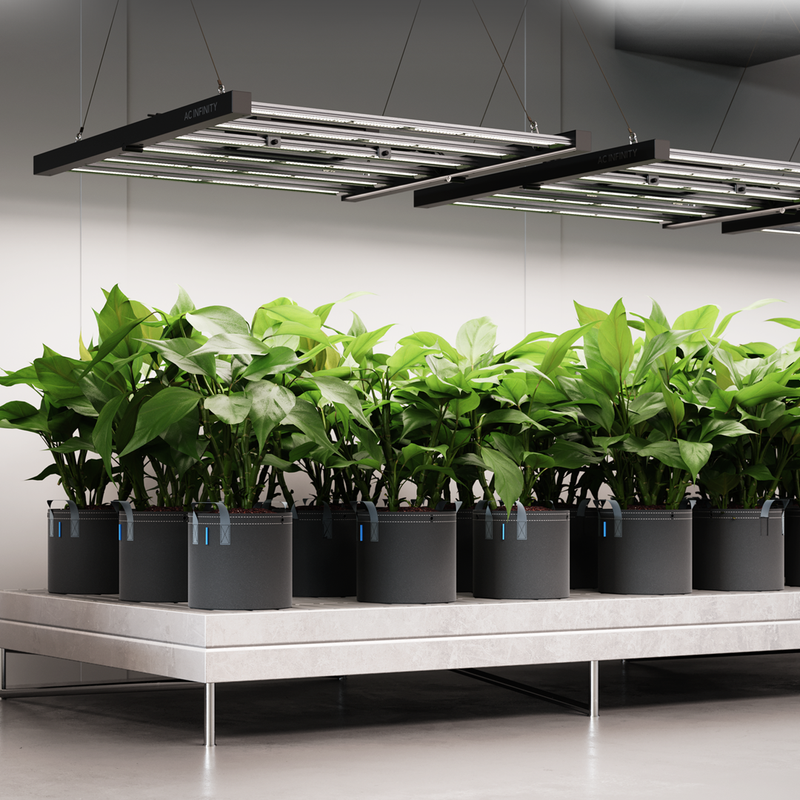
Best LED Grow Lights: How to Choose the Right AC Infinity Grow Light
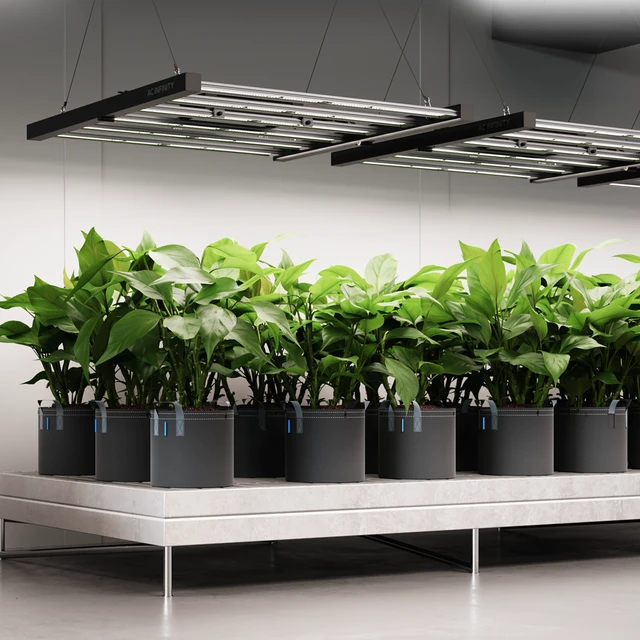
A grow light can make or break an indoor setup. You can have the tent dialed in, the airflow moving, and the environment looking perfect on your controller screen. But if the light isn't reaching the canopy properly, the rest of the setup can only do so much.
And no, buying the fixture with the biggest wattage number isn't automatically the answer.
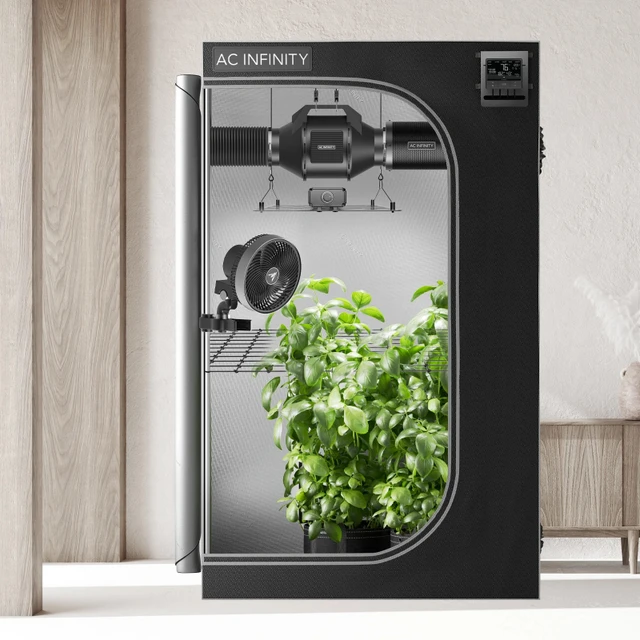
What matters is how that power is distributed, how much usable light reaches the plants, and whether the fixture actually suits the space you're growing in. A compact 2 × 2 tent has very different needs from a full 5 × 5 canopy. The right light should fit the room, not just look impressive on a spec sheet.
AC Infinity approaches indoor lighting through three main product families: IONBOARD, IONFRAME, and IONPRIME. They all deliver full-spectrum LED lighting, but their designs offer different levels of flexibility. Here's what separates them, where each one makes sense, and what to look at before choosing a fixture.
What Actually Makes a Good LED Grow Light?
Wattage gets most of the attention, but it's only one part of the picture. Two fixtures with similar power ratings can distribute light very differently. One might deliver strong intensity in the middle while leaving the edges of the canopy behind. Another might spread that output more evenly across the growing area.
A few things deserve more attention than the number printed on the box.
- Flowering coverage: Start with the manufacturer's recommended flowering footprint. This gives you a realistic baseline for matching a fixture to your tent.
- PPFD distribution: A PPFD map shows how much light reaches different parts of the canopy. Look beyond the strongest reading in the center.
- Efficiency: Photosynthetic photon efficacy, measured in µmol/J, indicates how efficiently a fixture converts electricity into photosynthetic light.
- Spectrum: Full-spectrum lighting provides a broad range of wavelengths for indoor plant growth. Some fixtures also include additional red, far-red, or UV diodes.
- Dimming and scheduling: Adjustable intensity and programmable schedules make it easier to adapt lighting as plants develop.
- Heat and installation: Driver placement, hanging height, ventilation, and clearance all affect how a fixture works inside an enclosed space.
The goal isn't to buy the most powerful light you can afford. It's to give the entire canopy the light it needs without creating unnecessary hot spots or making the environment harder to manage.
IONBOARD: Straightforward Lighting Without the Extra Fuss
Not every grower needs adjustable LED bars or a complicated lighting layout. Sometimes the priority is simple: find a fixture that fits the tent, hang it over the canopy, and get on with growing.
That's where IONBOARD comes in.
The IONBOARD series uses a flat, board-style design with LEDs distributed across a single fixture. It's a straightforward approach that works well for growers who want to match a light to a particular footprint without having to reposition individual bars.
The range covers several common tent sizes, from compact setups to larger 4 × 4 spaces.
IONBOARD models
- IONBOARD S22: 115W, 2 × 2 ft. coverage
- IONBOARD S24: 220W, 2 × 4 ft. coverage
- IONBOARD S33: 260W, 3 × 3 ft. coverage
- IONBOARD S44: 430W, 4 × 4 ft. coverage
The appeal is its simplicity. You aren't making decisions about bar angles or trying to customize the shape of the fixture. You choose the size that fits your growing area and position it above the canopy.
For growers running a compact tent or a more traditional layout, that can be all the flexibility they need.
IONFRAME: More Bars, More Canopy Coverage
Move up to IONFRAME and the design changes. Instead of concentrating the LEDs on one flat board, IONFRAME uses multiple LED bars arranged across the growing area.
That layout gives the fixture more points of light distribution across the canopy. It's particularly useful when you're illuminating a wider footprint and want to avoid relying on one concentrated area of output.
Selected EVO models use Samsung LM301H EVO LEDs and include programmable lighting controls, ten brightness levels, and sunrise and sunset dimming. The removable driver on the EVO series also gives growers more options for managing where heat from the driver is released.
The range includes several sizes, but the EVO10 is the big fixture in the lineup.
IONFRAME EVO: Model Comparison
The important detail with the EVO series is that coverage changes depending on the stage of growth. The flowering footprint is smaller than the vegetative footprint, and the supplemental CO₂ figures apply to sealed grow spaces using CO₂ enrichment.
| Model | Power | Vegetative Coverage | Flowering Coverage | Supplemental CO₂ Coverage |
|---|---|---|---|---|
| IONFRAME EVO3 | 280W | 3 × 5 ft. | 2 × 4 ft. | 1 × 3 ft. |
| IONFRAME EVO4 | 300W | 4 × 4 ft. | 3 × 3 ft. | 2 × 2 ft. |
| IONFRAME EVO6 | 500W | 5 × 5 ft. | 4 × 4 ft. | 3 × 3 ft. |
| IONFRAME EVO8 | 730W | 6 × 6 ft. | 5 × 5 ft. | 4 × 4 ft. |
| IONFRAME EVO10 | 1000W | 7 × 7 ft. | 6 × 6 ft. | 5 × 5 ft. |
Supplemental CO₂ coverage refers to sealed grow spaces using CO₂ enrichment at 1,300+ PPM, as specified in the IONFRAME EVO grow light manual.
A Closer Look at the IONFRAME EVO10
At 1,000 watts, the EVO10 is built for larger indoor growing areas. It uses 3,710 LEDs, including Samsung LM301H EVO diodes, with a full-spectrum output that also incorporates 395 nm UV, 660 nm red, and 730 nm far-red diodes.
But the coverage numbers are what make the fixture easier to place in context. The EVO10 is rated for a 7 × 7 ft. vegetative area and a 6 × 6 ft. flowering area. In a sealed grow space using supplemental CO₂ at 1,300+ PPM, its recommended coverage is 5 × 5 ft.
It also includes ten brightness levels, programmable scheduling, and sunrise and sunset dimming. The driver can be removed and mounted away from the light fixture, giving growers another option for managing heat in the grow space. With a compatible UIS controller, the light can also be integrated into the AC Infinity app for WiFi control and more advanced programming.
In other words, the EVO10 isn't simply a smaller fixture turned up to maximum power. It's designed around a larger canopy, with the output and controls to support a more involved indoor setup.
IONPRIME: When You Want to Move the Light Around
IONPRIME takes the multi-bar concept and adds another variable: adjustable angles.
Its LED bars can rotate up to 180 degrees, allowing growers to change how light is distributed across the canopy. That can be useful when the growing area isn't a perfect square, plants are arranged unevenly, or the PPFD map shows stronger intensity in one section than another.
Instead of accepting the fixture's default arrangement, you can adjust the bars to change the direction and spread of the light. The aim is to get more control over the canopy rather than simply increasing output.
IONPRIME models also include full-spectrum lighting, 0–100% dimming, programmable schedules, sunrise and sunset transitions, power outage memory, and compatibility with supported UIS controls.
IONPRIME Models
| Model | Power | Flowering Coverage | What Sets It Apart |
|---|---|---|---|
| IONPRIME 6 | 500W | 4 × 4 ft. | Adjustable-angle LED bars |
| IONPRIME 8 | 730W | 5 × 5 ft. | Adjustable-angle LED bars |
The difference between IONFRAME and IONPRIME becomes especially clear when you compare models with similar power. The IONFRAME EVO6 and IONPRIME 6 are both 500W fixtures with a 4 × 4 ft. flowering footprint. The distinction isn't the size of the space they cover. It's how much control you want over the position of the bars and the resulting light distribution.
If you like to fine-tune your layout, IONPRIME gives you another tool to work with. If you'd rather hang the fixture and keep the arrangement simple, IONFRAME may be the more natural fit.
IONBOARD vs. IONFRAME vs. IONPRIME: What's the Difference?
All three families are designed to light indoor growing spaces. The real difference is how they approach the job.
| Series | Fixture Design | Best Suited To | Main Advantage |
|---|---|---|---|
| IONBOARD | Flat LED board | Compact and medium-sized grow spaces | Simple, uncomplicated setup |
| IONFRAME | Multiple fixed LED bars | Growers prioritizing canopy-wide distribution | Bar-style layout and programmable lighting |
| IONPRIME | Adjustable-angle LED bars | Growers who want to customize light placement | More control over light distribution |
Think of it this way: IONBOARD keeps things simple, IONFRAME spreads the light across a bar-style fixture, and IONPRIME lets you change the angles to influence where that light goes. None is automatically better than the others. It comes down to the shape of your grow space and how hands-on you want to be with lighting placement.
Coverage Is Only Half the Story
A fixture's recommended coverage gives you a starting point, but it doesn't tell you everything about what happens at canopy level.
Hanging height changes how light spreads. Dimming changes intensity. Plant height and canopy shape can create areas that receive more or less light than others. Even a fixture rated for the right footprint can produce uneven results if it's installed poorly or the canopy has grown beyond the intended area.
This is why PPFD maps are worth looking at. They show how light is distributed across a measured area, rather than relying on a single peak number. If the center of the map is much brighter than the edges, that tells you something important about how the fixture is performing.
For growers using adjustable fixtures like IONPRIME, the bars can be repositioned to influence that distribution. After making changes, take readings at canopy level rather than assuming a new arrangement has automatically improved things.
It's also worth remembering that more light means more environmental considerations. High-output fixtures can contribute heat to an enclosed grow space. Driver placement, exhaust capacity, circulation, and the distance between the light and canopy all play a role in keeping conditions manageable.
Can You Automate Your Grow Light?
Lighting schedules are one of the easier parts of an indoor grow to automate, and they can make day-to-day management a lot less hands-on.
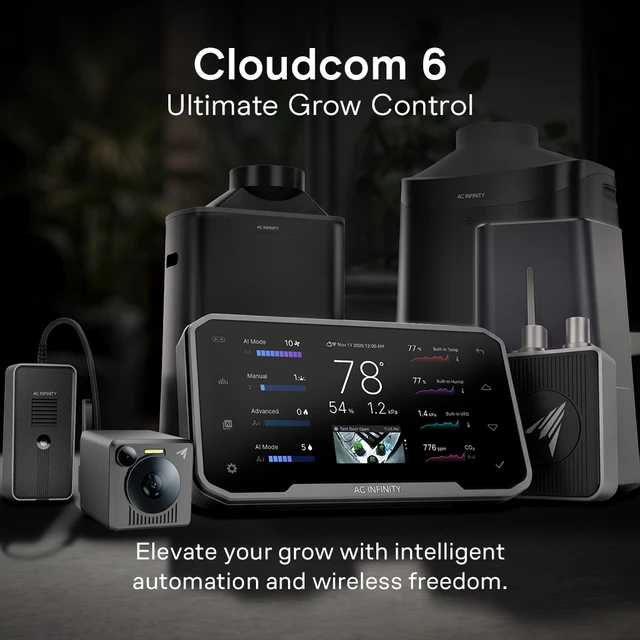
The selected IONFRAME EVO models include programmable schedules, ten brightness levels, and gradual sunrise and sunset dimming. IONPRIME adds its own programmable controls and compatibility with supported UIS devices. With a compatible controller, lighting can become part of a broader environmental setup alongside ventilation and other connected equipment.
That doesn't mean automation should replace understanding what the plants need. It means you can set a consistent routine and spend less time manually switching equipment on and off.
The useful part is coordination. Lighting, temperature, and ventilation don't operate in isolation. A change in lighting intensity can affect the environment inside the tent, so being able to manage connected equipment from one system can make the overall setup easier to control.
So, Which AC Infinity Grow Light Makes Sense?
Start with the space you're actually growing in. Measure the canopy, consider the flowering footprint you need, and think about whether you want a simple fixture or more control over light placement.
- Choose IONBOARD if you want a straightforward board-style fixture matched to a compact or medium-sized growing area.
- Choose IONFRAME if you prefer a multi-bar layout, programmable lighting, and broad light distribution across the canopy.
- Choose IONPRIME if you want adjustable-angle bars and more control over how light is directed around your plants.
For larger grows, the IONFRAME EVO10 brings 1,000W of output, Samsung LM301H EVO LEDs, and coverage rated at 6 × 6 ft. for flowering. Its larger vegetative footprint and supplemental CO₂ coverage make it a more specialized option for growers running bigger or more advanced environments.
There's no trophy for buying the biggest fixture. A well-matched light with even coverage is going to be more useful than an oversized one that doesn't suit the space.
Take the time to match the fixture to your canopy, look at how the light is distributed, and think about how much adjustability you actually need. Once those pieces line up, the rest of the setup has a much better foundation.
Explore the AC Infinity LED grow light collection to find a fixture that fits the way you grow.