


Grow Tent Climate Control: How to Manage Temperature, Humidity, Airflow, and VPD
People love talking about grow lights.
If you spend enough time in growing communities, you'll find endless debates about spectrum, wattage, PPFD maps, and whether somebody really needs another fixture hanging over a plant that's already getting more light than it knows what to do with. Lighting gets attention because it's visible. You can point to it. You can photograph it. You can immediately see the impact.
Grow tent climate control is different.
Nobody posts glamour shots of perfectly balanced humidity. Nobody gets excited about stable vapor pressure deficit readings. Nobody gathers around to admire a ventilation system quietly doing its job in the background. Yet the growers producing consistently healthy plants usually have one thing in common. They've stopped thinking of climate control as an accessory and started treating it as the foundation of the entire grow.
That's because plants don't experience a grow tent the same way humans do.
People walk into a room and think it feels fine. Plants experience a complex interaction between temperature, humidity, airflow, transpiration, and light intensity. When one of those variables drifts too far out of range, the effects begin to stack. Growth slows. Leaves start sending signals. Environmental stress builds. Before long, growers find themselves troubleshooting symptoms without realizing the climate itself is creating the problem.
Grow tent climate control is what separates a grow that feels unpredictable from one that feels manageable.
What Is Grow Tent Climate Control?
Grow tent climate control is the process of managing temperature, humidity, airflow, and vapor pressure deficit (VPD) inside an indoor growing environment. A properly designed grow tent climate control system helps maintain stable conditions that support healthy plant growth, efficient nutrient uptake, and consistent development throughout every stage of the grow cycle.
Rather than treating temperature and humidity as separate variables, modern growers increasingly view climate control for grow tents as a complete environmental management strategy. Every factor inside the tent affects the others, making stability one of the most important goals of indoor cultivation.
Whether you're growing vegetables, herbs, tropical plants, or specialty crops, effective indoor grow tent climate control helps create an environment where plants can thrive without constantly fighting environmental stress.
Benefits of Proper Grow Tent Climate Control
Proper grow tent climate control offers several important advantages: • Faster and more consistent plant growth • Improved nutrient and water uptake • Better transpiration rates • Reduced risk of mold, mildew, and disease • More stable VPD conditions • Healthier root and foliage development • Higher-quality harvests and improved yields • Less time spent correcting environmental problemsThe appeal of a grow tent has always been control.
Outdoor growers spend their seasons negotiating with weather patterns. Indoor growers build a box and attempt to create their own version of nature. The moment you zip up a grow tent, you're essentially becoming responsible for everything that happens inside it.
That sounds empowering until you realize how quickly conditions can change.
Lights generate heat. Plants release moisture. Equipment affects airflow. Seasonal weather outside the tent influences the environment inside the tent. Even opening the door for a few minutes can alter conditions enough to shift temperature and humidity readings.
Why Grow Tent Climate Control Matters
Many growers focus heavily on lighting, nutrients, and genetics while overlooking the environment those plants live in every day. However, even the best equipment and genetics can underperform when climate conditions fluctuate too often. Plants rely on stable environmental conditions to regulate transpiration, absorb nutrients, and maintain healthy growth. When temperature, humidity, or airflow become inconsistent, plants spend more energy adapting to environmental stress and less energy growing.
A well-designed grow tent climate control system creates consistency. That consistency is often what separates successful grows from frustrating ones.
Ventilation and Exhaust in Grow Tent Climate Control
Without proper ventilation, heat accumulates. Humidity rises. Air becomes stagnant. Plants are forced to work harder just to function normally. It doesn't matter how expensive the lights are if the environment surrounding the plants isn't supporting healthy growth.
A properly designed exhaust system continuously removes stale air while bringing fresh air into the grow space. That process helps regulate temperature, reduce excess humidity, and maintain healthy levels of gas exchange. The challenge is creating airflow without turning the grow tent into a wind tunnel.
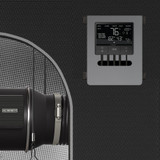
This is where systems like the AC Infinity Cloudline series series have become popular among indoor growers. Rather than simply running at a fixed speed, CLOUDLINE inline fans can respond dynamically to environmental conditions when paired with smart controllers.
The result is a grow space that feels less reactive and more stable. Instead of waiting for temperatures to spike before making adjustments, the system works continuously to maintain balance. Good ventilation often goes unnoticed because it's working exactly as intended. The moment airflow becomes inadequate, however, every other environmental problem tends to show up shortly afterward.
Temperature Management for Effective Grow Tent Climate Control
Temperature management is one of the most misunderstood aspects of indoor cultivation.
Many growers think of temperature as a single number they need to keep within a certain range. In reality, temperature influences nearly every biological process happening inside a plant.
Too much heat increases transpiration and stress. Temperatures that are too low can slow metabolic activity and reduce growth rates. Even relatively small fluctuations can impact how efficiently plants use water and nutrients. The problem becomes more complicated once lighting enters the picture.
Modern LED systems generate less radiant heat than older technologies, but they still contribute to the overall thermal load inside a grow tent. During warmer months, temperatures can rise surprisingly quickly, especially in smaller spaces. Many growers address this challenge using a combination of ventilation and dedicated climate management equipment. AC Infinity's THERMOFORGE heaters help stabilize temperatures during colder periods, while our TERRAFORM air conditioners provide cooling solutions when heat becomes difficult to manage.
Plants generally respond better to stable environmental conditions than they do to constant fluctuations, even when those fluctuations remain within technically acceptable ranges.
Humidity Control and Grow Tent Climate Control Success
Humidity rarely gets the attention it deserves because it's harder to see than temperature. You can feel heat immediately. Humidity tends to reveal itself indirectly through its effects on plant health, transpiration, and disease pressure.
Young plants often benefit from higher humidity levels because their root systems are still developing. As plants mature, excessive humidity can create an environment where problems begin to emerge. Moisture accumulates. Air movement becomes more important. Pathogens find opportunities.
Equipment designed specifically for humidity management makes maintaining stable conditions significantly easier. The AC Infinity HUMIDIFIER series helps increase moisture levels during dry periods, while the THERMOFORGE and TERRAFORM systems can contribute to broader environmental regulation.
For growers dealing with persistently high humidity, dehumidifiers provide another layer of control that helps maintain healthier conditions throughout the grow cycle.
VPD and Grow Tent Environmental Control
There was a time when growers discussed temperature and humidity as completely separate variables. Then VPD entered the conversation.
Vapor Pressure Deficit (VPD) measures the relationship between temperature and humidity. Rather than viewing those factors independently, VPD helps growers understand how environmental conditions influence plant transpiration. When VPD falls outside an ideal range, plants may struggle to transpire efficiently. Water movement slows. Nutrient transport can become less effective. Growth may become less vigorous than expected. One reason VPD has gained popularity is because it provides context.
A temperature reading alone doesn't tell the entire story. Neither does humidity. Together, they create a more complete picture of the environment plants are actually experiencing.
Growers who begin monitoring VPD often discover that many environmental issues become easier to understand once they start viewing climate as an interconnected system rather than a collection of isolated numbers.
Smart Controllers and Automated Grow Tent Climate Control
Growers checked thermometers, adjusted fan speeds, monitored humidity levels, and made changes throughout the day. The process worked, but it required attention and experience. Modern controllers have changed that dynamic significantly.
Instead of simply monitoring environmental conditions, smart controllers actively respond to them. Equipment turns on when it's needed. Fan speeds increase automatically. Temperature and humidity thresholds trigger adjustments without requiring constant oversight.
The AC Infinity Controller AI+ and Controller 69 series represent this shift toward automated grow tent climate control.
These systems collect data from multiple sources and coordinate connected equipment to maintain stable growing conditions. Rather than managing each device independently, growers can create automated responses that keep environmental variables within target ranges.The Future of Grow Tent Climate Control
The future of grow tent climate control looks increasingly intelligent.
Sensors continue becoming more sophisticated. Automation systems continue becoming more capable. Environmental monitoring continues moving toward a model where equipment not only reports conditions but actively optimizes them. The interesting part is that much of this technology already exists.
Today's growers can monitor temperature, humidity, VPD, airflow, and equipment performance from a smartphone. They can automate environmental responses and maintain growing conditions with a level of precision that would have seemed excessive a decade ago.
Grow tent climate control isn't the most exciting topic in cultivation. It doesn't produce dramatic before-and-after photos, and it rarely becomes the centerpiece of social media posts. What it does provide is something far more valuable: stability.
Ventilation, temperature management, humidity control, VPD monitoring, and smart controllers all work together to create an environment where plants can thrive without constantly fighting their surroundings.
Products like the AC Infinity CLOUDLINE series, THERMOFORGE heaters, TERRAFORM air conditioners, dehumidifiers, humidifiers, and Controller AI+ systems make that process significantly easier. More importantly, they help growers shift their focus away from reacting to problems and toward maintaining a healthy environment from the start.
Because at the end of the day, the best growers aren't usually the ones making the most adjustments. They're the ones who created an environment that didn't need many adjustments in the first place.
Frequently Asked Questions About Grow Tent Climate Control
What is grow tent climate control?
Grow tent climate control is the process of regulating temperature, humidity, airflow, and VPD inside a grow tent to create optimal conditions for healthy plant growth.
Why is grow tent climate control important?Proper climate control helps plants absorb nutrients more efficiently, maintain healthy transpiration rates, and avoid environmental stress caused by excessive heat, humidity, or poor airflow.
What equipment is used for grow tent climate control?Most grow tent climate control systems include inline fans, exhaust systems, humidifiers, dehumidifiers, heaters, air conditioners, environmental sensors, and smart controllers.
What temperature should a grow tent be?The ideal temperature depends on the plant species and growth stage, but maintaining stable temperatures is generally more important than chasing a single number.
How does humidity affect grow tent climate control?Humidity affects transpiration, nutrient movement, disease pressure, and overall plant health. Maintaining proper humidity levels helps create a healthier growing environment.
What is VPD in a grow tent?VPD, or Vapor Pressure Deficit, measures the relationship between temperature and humidity and helps growers understand how efficiently plants are transpiring.
Can grow tent climate control be automated?Yes. Modern smart controllers can automatically adjust fans, heaters, humidifiers, dehumidifiers, and other connected equipment to maintain consistent environmental conditions with minimal manual intervention.


