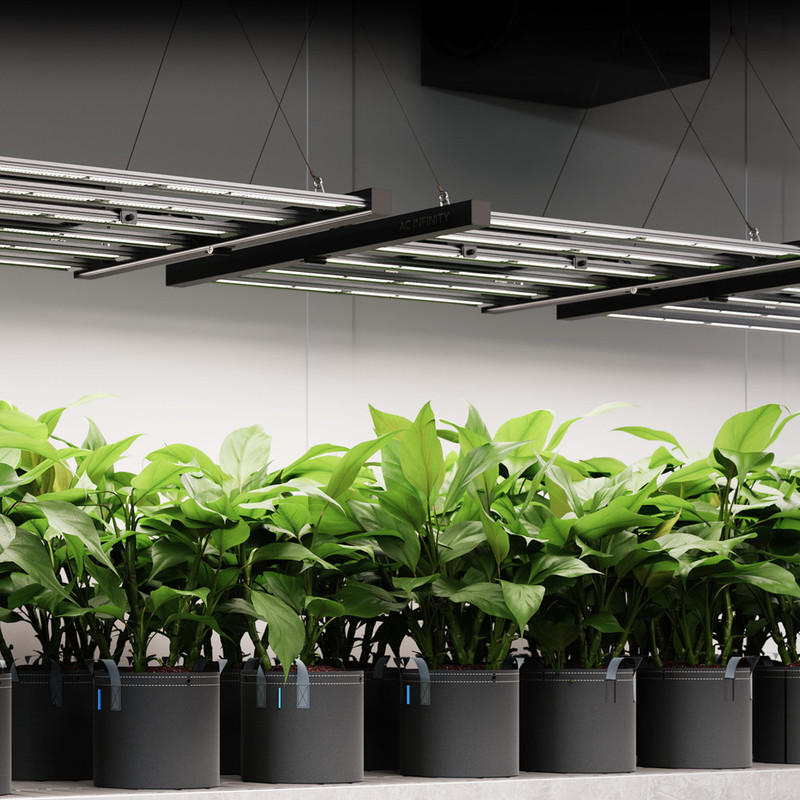
Full Spectrum Grow Lights: What They Are and How to Choose the Right One
Growing indoors gives you control over nearly every part of the environment, but there is one thing plants cannot compromise on: light. Without enough of the right light, even a carefully managed grow space can struggle to reach its potential. That is where full spectrum grow lights come into play.
- Full spectrum LED grow lights provide a broad range of wavelengths designed to support plants throughout multiple stages of growth.
- Choosing the right light involves more than wattage. Coverage, PPFD, light distribution, spectrum, dimming, heat management, and controls all matter.
- Bar-style fixtures can help distribute light across larger growing areas, while LED boards can be practical for more compact spaces.
- The best grow light is the one that matches your grow-space dimensions, canopy, desired intensity, and level of control.
Unlike ordinary household lighting, full spectrum LED grow lights are designed to provide the wavelengths of light plants can use during different stages of growth. Modern LED fixtures can also deliver high light output while giving growers more control over intensity, coverage, scheduling, and energy use.
For indoor growers, choosing the right light is about more than simply looking at wattage. Coverage area, light distribution, spectrum, efficiency, dimming, mounting height, and control options all play a role in creating a productive growing environment.
What Are Full Spectrum Grow Lights?
Full spectrum grow lights are designed to provide a broad range of wavelengths that can support plants throughout their growth cycle. Rather than using a narrow portion of the visible spectrum, full spectrum LED grow lights are engineered to provide a more comprehensive light output suitable for different stages of plant development.
This makes them particularly useful for indoor growing because one fixture can remain over the plants from early growth through flowering. Instead of switching between different types of lighting as the plants mature, growers can use a properly selected full spectrum grow light throughout the cycle.
Full spectrum isn't a universal specification
The exact spectrum varies between fixtures, so "full spectrum" should not be treated as a guarantee that every grow light produces the same output. LED technology, diode selection, spectrum design, fixture layout, and intensity all influence how the light reaches the canopy.
AC Infinity's commercial grow lights include both bar-style fixtures and LED boards designed around different growing spaces. The IONFRAME grow light series, for example, includes fixtures designed around even coverage, deep canopy penetration, and reduced hotspots.
Why Use Full Spectrum LED Grow Lights?
One of the biggest advantages of full spectrum LED grow lights is versatility. A grower can use the same lighting system across multiple stages rather than building an entirely different lighting setup for each phase.
Versatile Spectrum
Full spectrum lighting can support plants across multiple stages of development using the same properly selected fixture.
Natural-Looking Light
White full spectrum lighting can make it easier to visually inspect plants, identify discoloration, evaluate canopy health, and perform routine maintenance.
Multiple Footprints
LED technology allows fixtures to be designed around different power levels and coverage areas, helping growers match lighting to their actual space.
Adjustable Output
Dimming and smart controls can provide greater flexibility as plants develop and their lighting requirements change.
For example, AC Infinity's IONFRAME lineup includes the IONFRAME EVO3 at 280W for 2×4 coverage, the IONFRAME EVO6 at 500W for 4×4 coverage, and the IONFRAME EVO8 at 730W for 5×5 coverage.
Full Spectrum Does Not Mean One Size Fits All
A common mistake when shopping for full spectrum grow lights is assuming that the highest wattage is automatically the best option. More power can be useful, but only when the fixture is appropriate for the growing area.
The goal is to match the fixture to the growing area, not simply choose the highest wattage available.
A 1,000W grow light installed over a small growing area could provide far more light than necessary. Meanwhile, an underpowered fixture may struggle to provide sufficient intensity across a larger canopy.
- Growing area: Measure the actual footprint you need to illuminate.
- Power: Consider wattage alongside the fixture's intended coverage.
- PPFD: Look at how much usable light reaches the canopy rather than relying solely on wattage.
- Light distribution: Even coverage can be more useful than extreme intensity in one central area.
- Dimming: Adjustable intensity allows you to change output as plants develop.
- Controls: Smart programming can simplify schedules and automation.
- Heat management: Consider where the driver is located and how the fixture handles heat.
Choosing the Right Full Spectrum Grow Light
The easiest place to start is your grow-space dimensions. Once you know the area you need to illuminate, you can narrow your options based on the manufacturer's recommended coverage.
Here are several options from AC Infinity's IONFRAME commercial grow-light lineup:
| Full Spectrum Grow Light | Power | Coverage | Key Features |
|---|---|---|---|
| IONFRAME EVO3 | 280W | 2×4 | Samsung LM301H EVO LEDs, smart scheduling, 10 brightness levels |
| IONFRAME EVO4 | 300W | 3×3 | Full spectrum LED lighting and programmable controls |
| IONFRAME EVO6 | 500W | 4×4 | Samsung LM301H EVO LEDs, even coverage, hotspot reduction |
| IONFRAME A7 | 700W | 4×5 | 3000K, 5000K, and 660nm LEDs, IP67-rated build |
| IONFRAME EVO8 | 730W | 5×5 | Samsung LM301H EVO LEDs, smart controls, 5×5 flower coverage |
| IONFRAME EVO10 | 1000W | 5×5 | High-output full spectrum lighting for larger indoor grows |
The IONFRAME EVO3, IONFRAME EVO6, and IONFRAME EVO8 use Samsung LM301H EVO LEDs, with the EVO models supporting scheduling, sunrise and sunset dimming, and 10 brightness levels through the UIS platform.
Why Light Distribution Matters
Wattage tells you how much electrical power a fixture uses. It does not tell you exactly how evenly that light reaches the plants.
That is why growers should pay attention to PPFD maps and light distribution when comparing full spectrum grow lights. PPFD measures the amount of photosynthetically active light reaching a particular area of the canopy.
A fixture may concentrate much of its intensity directly beneath the center, creating higher intensity in one area of the canopy.
A fixture that spreads light more evenly can provide more consistent intensity across a larger portion of the canopy.
This is one reason bar-style LED grow lights have become popular for larger indoor growing areas. By spreading LEDs across multiple bars, manufacturers can distribute the light source over a larger footprint rather than concentrating everything into one central board.
The IONFRAME series is designed around this concept, using algorithmically spaced LEDs across a bar-style fixture to promote even coverage, deeper penetration, and reduced hotspots.
Want more control over light direction?
Growers can also explore the IONPRIME Series. IONPRIME fixtures use independently adjustable LED bars that can be angled to reshape light distribution based on the canopy.
Full Spectrum Grow Lights and Plant Growth Stages
Another major advantage of full spectrum lighting is its versatility across the growing cycle.
Plants need an appropriate amount of usable light without overwhelming a developing canopy.
As plants become larger, growers can gradually increase light intensity depending on the plant, environment, and growing goals.
A larger and more developed canopy can require substantially more light, making properly sized lighting particularly important.
A dimmable full spectrum LED grow light gives growers more flexibility than a fixture that operates at only one output level. Instead of having the light permanently locked at maximum power, growers can adjust intensity as plants develop.
AC Infinity's IONFRAME EVO fixtures include programmable dimming and 10 brightness levels, while their drivers can connect with the UIS ecosystem for scheduling and app-based control.
Full Spectrum Grow Lights vs. Traditional Grow Lights
LED technology has changed what growers can expect from an indoor lighting system. Traditional high-intensity lighting technologies can generate significant heat and may require additional infrastructure to manage that heat.
Modern LED fixtures can be designed around passive cooling, efficient diodes, and removable drivers. This can give growers more flexibility when arranging equipment inside a grow tent or larger indoor growing environment.
Heat Management
The IONFRAME EVO series uses removable drivers, allowing the driver to be mounted away from the fixture to help manage heat.
Scalable Connectivity
The fixtures support daisy-chaining, with AC Infinity stating that EVO models can connect up to 80 grow lights.
That scalability can become particularly useful in commercial or multi-light installations where several fixtures need to operate together.
Smart Controls Add Another Layer of Control
A quality grow light does not necessarily need to be complicated, but smart controls can make a lighting schedule much easier to manage.
Instead of manually turning lights on and off every day, programmable systems can automate schedules and gradual brightness changes. Sunrise and sunset dimming can also provide a more gradual transition between lighting levels.
- Schedule controls
- Sunrise and sunset dimming
- 10 brightness levels
- UIS platform integration
This becomes even more useful when lighting is part of a larger indoor growing system. Lighting, ventilation, and environmental controls can be managed together rather than treated as completely separate pieces of equipment.
Consider an LED Board for Smaller Spaces
Not every indoor growing setup needs a large bar-style fixture. For smaller spaces, an LED board can be a practical alternative.
AC Infinity's IONBOARD series uses a unibody aluminum construction and Samsung LM301H LEDs. The diodes are algorithmically positioned across the board to create uniform PAR coverage and deeper canopy penetration.
115W LED board designed for 2×2 growing spaces.
430W LED board designed for 4×4 coverage.
The IONBOARD S24, for example, uses full spectrum Samsung LM301H LEDs and features 0-100% dimming, smart-controller compatibility, and an IP65-rated aluminum construction. Growers can compare available models through the IONBOARD LED grow light collection.
How High Should a Full Spectrum Grow Light Hang?
There is no universal mounting height that works for every fixture or plant. The correct height depends on the light's output, coverage, plant development, and desired intensity.
This is another reason PPFD measurements and manufacturer-provided PAR maps are useful. Instead of guessing based solely on how bright the fixture looks, growers can use actual measurements to determine how much light is reaching the canopy.
As plants grow closer to the light, intensity generally increases.
Moving the fixture farther away spreads the light over a larger area but can reduce intensity at the canopy.
The goal is to find a mounting height and intensity that provide appropriate coverage without creating unnecessary hotspots.
Build Your Lighting System Around the Grow Space
The best full spectrum grow light is not necessarily the most powerful one. It is the fixture that matches your growing area, provides appropriate light distribution, offers enough intensity for your plants, and gives you the level of control you actually need.
2×4 Grow Space
A smaller fixture such as the IONFRAME EVO3 may make more sense for a compact 2×4 setup.
4×4 Grow Space
A 4×4 grow space could benefit from something like the 500W IONFRAME EVO6.
4×5 Grow Space
The IONFRAME A7 provides a 700W option with 3000K, 5000K, and 660nm LEDs, an IP67-rated build, removable driver, daisy-chain capability, and UIS integration.
5×5 Grow Space
Larger 5×5 spaces can step up to the IONFRAME EVO8 or IONFRAME EVO10 depending on the desired output.
Growers looking for a different approach to canopy coverage can also compare AC Infinity's IONPRIME multi-angle grow lights, which add adjustable LED bars for greater control over light direction and distribution.
Final Thoughts on Full Spectrum Grow Lights
Full spectrum grow lights give indoor growers a versatile way to provide plants with broad-spectrum lighting throughout the growing cycle. But choosing the right fixture requires looking beyond the phrase "full spectrum."
Consider the size of your growing area, the fixture's recommended coverage, PPFD distribution, power, dimming capability, heat management, and control options. A well-matched fixture can provide more consistent lighting across the canopy while giving you the flexibility to adjust intensity as your plants develop.
For growers looking for scalable, controllable LED lighting, AC Infinity's IONFRAME commercial grow light lineup offers several options ranging from compact 2×4 fixtures to high-output 5×5 systems. The IONFRAME series combines full spectrum LED technology with bar-style light distribution, smart programming, and scalable connectivity, giving growers more control over how their indoor lighting system operates.
Growers can also explore the IONPRIME Series for adjustable multi-angle lighting or the IONBOARD Series for compact LED board options.
FAQ: Full Spectrum Grow Lights
What are full spectrum grow lights?
Full spectrum grow lights are LED fixtures designed to provide a broad range of light wavelengths suitable for supporting plants throughout their growth cycle.
Are full spectrum LED grow lights good for indoor growing?
Yes. Their broad-spectrum output and adjustable intensity make them versatile for indoor growing, particularly when the fixture is properly matched to the growing area.
How do I choose a full spectrum grow light?
Start with your growing area's dimensions, then compare the fixture's recommended coverage, PPFD, power, spectrum, dimming capabilities, and available controls.
Are more watts always better?
No. Wattage alone does not determine how effectively a grow light illuminates a canopy. Coverage and PPFD distribution are also important factors.
Can I use one full spectrum grow light for the entire grow cycle?
Many full spectrum LED grow lights are designed for use across multiple stages of plant growth. Adjustable intensity makes it easier to adapt the light output as plants develop.
Build Your Lighting Around Your Grow Space
Choosing the right setup means matching light output, coverage, and environmental control to your growing space.
The best full spectrum grow light is not necessarily the most powerful fixture. It is the one that delivers the coverage, distribution, intensity, and control your growing space actually needs.
Compare your grow-space dimensions with recommended coverage and PPFD distribution, then consider the fixture's spectrum, dimming, heat management, and control options.