Grow Tents vs. Grow Rooms: A Basic Overview
As an indoor grower, one of the first decisions you'll need to make is where your plants will actually grow.
You can dedicate an entire room in your home to growing, creating what's commonly called a grow room, or use a high-quality grow tent to convert part of an existing space into a controlled growing environment.
Both approaches can work. The better fit depends on factors such as available space, growing scale, budget, customization, and how permanent you want the setup to be.
- Grow tents provide a self-contained growing environment within an existing room.
- Tents are generally quicker, easier, and more cost-effective to set up.
- Grow rooms can provide substantially more growing space for larger operations.
- A dedicated room provides greater freedom to customize the entire environment.
- Smaller tent environments can be easier and less expensive to control.
- Grow tents can be disassembled and stored when they're no longer needed.
- The right choice depends on your available space, budget, and growing goals.
Grow Tent vs. Grow Room
| Consideration | Grow Tent | Grow Room |
|---|---|---|
| Setup | Generally quicker and easier | Usually requires more preparation |
| Cost | Typically more cost-effective | Generally more expensive to build and operate |
| Space | Available in compact to large sizes | Can use an entire room |
| Climate Control | Smaller enclosed area can simplify control | Larger environment can require more equipment and planning |
| Customization | Highly configurable | Greater freedom for complete customization |
| Portability | Can be disassembled and stored | Generally a more permanent setup |
| Growing Scale | Well suited to small and moderate setups | Can accommodate larger-scale operations |
Grow Tents

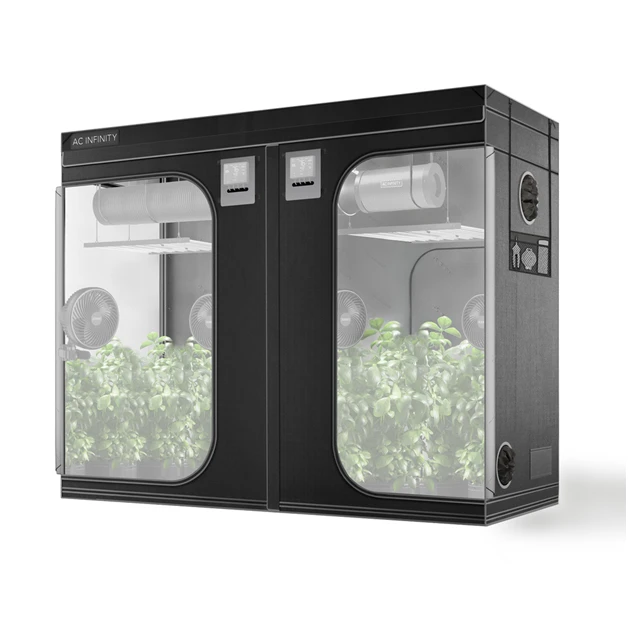
Grow tents vary considerably in size. Small tents may only measure a few feet by a few feet, allowing them to fit inside bedrooms, small rooms, or walk-in closets.
Larger grow tents can reach 10 x 10 feet or more, giving indoor growers considerable flexibility when choosing a growing space.
One of the biggest advantages of a dedicated grow tent is that the environment can be largely self-contained. Instead of controlling the climate throughout an entire room, you can create a smaller growing environment inside the tent.
Controlled Environment
A grow tent creates a contained space where temperature, humidity, light, and airflow can be managed around your plants.
Lower Setup Barrier
Compared with converting an entire room, grow tents are generally quicker, easier, and more cost-effective to set up.
Flexible Placement
Smaller tents can fit into existing rooms, closets, and other available spaces without dedicating an entire room to growing.
Easy Storage
When the growing space isn't needed, a tent can be disassembled and stored with relative convenience.
Easier Environmental Control
Because grow tents are generally smaller than dedicated grow rooms, maintaining temperature, humidity, ambient light, and other environmental conditions can be easier.
Controlling a smaller volume of air can also make heating, cooling, humidification, dehumidification, and ventilation more cost-effective than conditioning an entire room.
Manage heating and cooling within a smaller enclosed environment.
Maintain moisture levels around the requirements of your plants.
Contain and direct grow lighting within the growing space.
Configure ventilation and circulation around the size of the tent.
Durability & Customization
A grow tent doesn't have the permanent construction of a dedicated room, but high-quality tents can still use strong frames and durable materials that can last for many growing cycles with proper care.
Grow rooms may offer more freedom for complete customization, but grow tents can still be highly configurable with lighting, ventilation, environmental controls, containers, and other growing equipment.
Where Grow Tents Have Limits
The available growing area is ultimately limited by the size of the tent. Growers planning larger operations may need multiple tents, a substantially larger tent, or a dedicated grow room.

Grow Rooms
A grow room is a space within a home or building that is specifically designated and configured for growing plants indoors.
Because you're working with an entire room, the available growing area can exceed what is practical with many commercially available grow tents. This can make dedicated grow rooms useful for growers planning larger-scale setups.
More Growing Space
An entire room can provide substantially more usable growing area than a smaller grow tent.
Greater Customization
Heating, cooling, ventilation, humidity control, lighting, and the physical layout can all be configured around the room.
Larger-Scale Potential
The additional space can better accommodate growers who want to operate at a larger scale.
The Tradeoff of a Larger Environment
A grow room provides greater freedom, but controlling a larger environment can require more planning.
Insulation, lighting, heating, cooling, ventilation, and humidity management all need to work together to maintain appropriate conditions throughout the room.
More growing space gives you more flexibility, but it also means more space that needs to be lit, ventilated, heated, cooled, and controlled.
Smaller enclosed environments can make precise climate control more straightforward and cost-effective.
A larger environment provides greater flexibility, but may require more equipment and planning to maintain consistently.
Cost & Setup
Setting up and maintaining an entire grow room is generally more expensive than setting up a grow tent.
Beyond the initial conversion, lighting, heating, cooling, ventilation, and other equipment may need to support a much larger space. Building the room can also require considerably more time than assembling a tent.
A dedicated grow room is also less portable. Once a room has been configured around indoor growing, returning it to its previous use can require considerably more work than simply disassembling a tent.
Which Is Right for You?
Ultimately, one approach isn't universally better than the other.
For some growers, dedicating an entire room provides the space and customization their operation requires. For others, a grow tent provides the convenience, environmental control, and growing area they need without converting an entire room.
- You have limited available space.
- You want a smaller controlled environment.
- You want a quicker setup.
- You want to keep initial costs lower.
- You may need to move or store the setup later.
- You're growing on a smaller or moderate scale.
- You have an entire room available.
- You want substantially more growing space.
- You're planning a larger-scale setup.
- You want maximum freedom to customize the space.
- You're comfortable with a more permanent installation.
- Your budget can accommodate a larger controlled environment.
Plan the Environment, Not Just the Space
Whether you choose a grow tent or a dedicated room, the physical space is only the foundation of the indoor growing environment.
Select a grow tent or room based on the scale of your setup.
Provide appropriate light coverage throughout the growing area.
Add ventilation and circulation to manage the growing environment.
Manage temperature, humidity, and other environmental conditions.
Build the Growing Space That Works for You
Grow tents and dedicated grow rooms can both provide the controlled environment needed for successful indoor growing.
The key differences come down to space, cost, setup time, portability, growing scale, and the amount of customization you need.
Choose the space that fits your operation, then build the lighting, airflow, and environmental controls around it.