Vent Booster Fans: The Quiet Fix for Grow Rooms
There is a certain kind of room that slowly drives people insane.
It is always hotter than the rest of the house in summer. Freezing in winter. Air feels trapped inside it like the room forgot how circulation works.
Maybe it is a second-floor bedroom. Maybe it is a converted office. Maybe it is the one room where your grow tent lives and temperatures somehow keep climbing no matter how hard the HVAC system works.
At first, people blame the thermostat. Then they blame the house.
Eventually they discover the uncomfortable truth that most homes do not distribute airflow evenly in the first place. Some rooms are simply too far from the HVAC system. Others lose pressure through long duct runs, restrictive vents, or weak circulation.
The system technically works, but the air never fully arrives where it needs to go.
That is where vent booster fans quietly enter the conversation.
Not as some flashy upgrade. Not as a complete HVAC replacement. More like a surprisingly effective solution for one of the most annoying environmental problems modern homes create.
- Vent booster fans help move conditioned air into rooms that receive weak airflow from a central HVAC system.
- They are designed to assist existing airflow, not replace an HVAC system.
- Modern booster fans can automatically respond to HVAC activity and temperature changes.
- Choosing the right booster fan starts with matching the unit to your existing vent dimensions.
- Noise, airflow capacity, automatic controls, and energy efficiency are also important considerations.
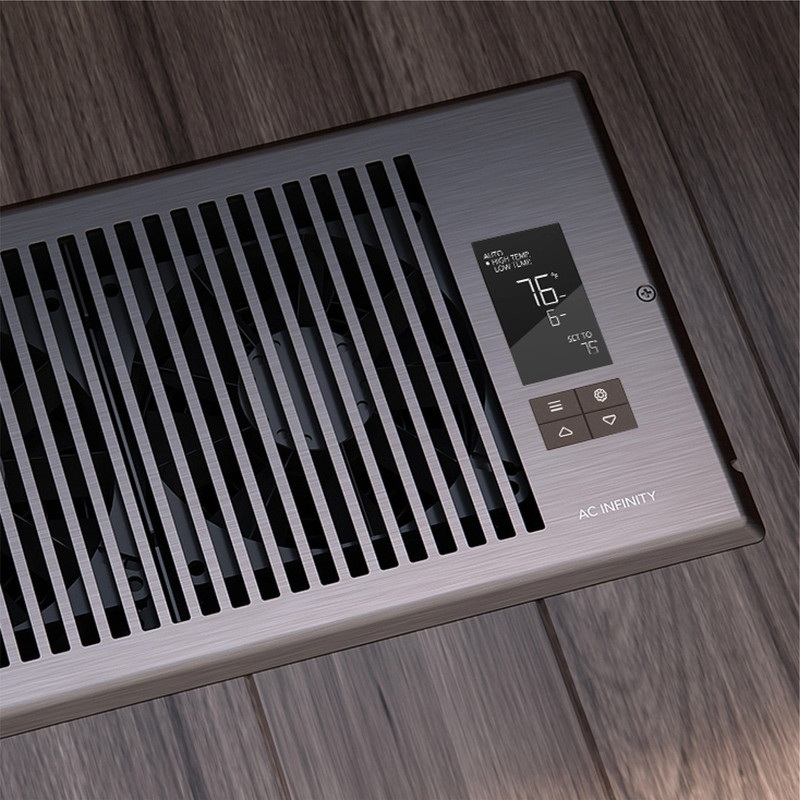
- AC Infinity AIRTAP combines targeted airflow with temperature-based controls and quiet PWM motor technology.
What Is the Purpose of a Vent Booster Fan?
A vent booster fan exists for one reason. It helps move conditioned air into rooms that are not getting enough airflow from the HVAC system alone.
Most central air systems are designed around the idea that air naturally distributes itself evenly through ductwork.
Real life does not work that way.
Air loses pressure over distance, struggles through bends in ducting, and weakens across multi-story homes.
- Hot upstairs bedrooms during summer
- Cold rooms during winter
- Weak airflow from vents
- Stuffy offices or gaming rooms
- Grow rooms with unstable temperatures
- Uneven temperatures throughout the house
Vent booster fans help solve this by actively pulling or pushing additional airflow from the HVAC system into the room itself.
The difference sounds small until you actually experience it. Suddenly the room that always felt disconnected from the rest of the house finally reaches a stable temperature without forcing the entire HVAC system to work harder.
Think Airflow Support, Not HVAC Replacement
A vent booster fan is not replacing your HVAC system. It is helping your existing airflow actually reach the spaces that need it.
How Do Vent Booster Fans Work?
The simplest explanation is that vent booster fans assist airflow exactly where airflow starts weakening.
Most models install directly into floor vents, wall vents, or ductwork. Once active, the fan increases air movement by pulling additional conditioned air through the vent opening and into the room.
Your central heating or cooling system begins sending conditioned air through the ductwork.
Airflow travels through the duct system toward the room.
The vent booster fan helps pull additional conditioned air through the vent opening.
Improved airflow helps the room maintain more consistent conditions.
Modern Booster Fans Add Automation
What makes modern vent booster fans more interesting is automation.
Older booster fans were essentially just small fans plugged into a vent. Modern systems behave more like environmental management tools. Many automatically detect airflow and activate only when the HVAC system turns on.
- The fan operates only when needed
- Energy usage stays lower
- Rooms maintain more stable temperatures
- HVAC airflow becomes more efficient
- Noise stays minimal during inactive periods
Some advanced systems also include:
The goal is not brute force airflow. The goal is controlled airflow that stabilizes the environment without turning your room into a wind tunnel.
That becomes especially important in grow spaces, offices, media rooms, and bedrooms where environmental consistency matters more than raw fan power.
Why Weak Airflow Becomes a Bigger Problem Than People Expect
People underestimate airflow because airflow is invisible.
You notice lighting immediately. You notice loud HVAC systems immediately. Air distribution problems happen slowly enough that most people adapt to them without realizing the environment itself feels wrong.
But poor airflow affects more than comfort.
Weak circulation creates rooms that constantly drift outside the temperature range the thermostat is trying to maintain.
Unstable airflow can contribute to heat buildup, humidity pockets, poor VPD stability, weak air exchange, and environmental swings.
In homes, the HVAC system keeps running longer because one section of the house never catches up.
In grow spaces, unstable airflow creates an entirely different category of problems:
- Heat buildup around lighting systems
- Humidity pockets around plants
- Poor VPD stability
- Weak air exchange inside tents
- Environmental swings during lights-off periods
The irony is that many setups technically have enough heating or cooling capacity already.
The issue is distribution. Conditioned air simply is not arriving consistently where it matters.
Vent booster fans solve that specific problem directly.
How to Find the Right Size Vent Booster Fan
This is where people often overcomplicate things.
Finding the right vent booster fan is usually less about maximum fan power and more about matching airflow support to the actual vent size and environmental conditions.
1. Measure Your Vent
The first thing to check is vent dimensions.
Most residential vents fall into common sizes like:
Choosing the correct fit matters because undersized fans leave airflow gaps while oversized systems reduce efficiency and create awkward installation problems.
2. Consider the Room
After vent size, airflow demand becomes the next factor.
Second-Story Bedrooms
Upper floors can experience uneven temperatures when conditioned air weakens across longer duct runs.
Attics & Converted Lofts
Converted spaces may struggle with consistent airflow and temperature management.
Home Offices
Enclosed workspaces can become uncomfortable when airflow from the HVAC system is weak.
Grow Rooms
Consistent conditioned airflow can support more stable environmental conditions.
Distant Rooms
Rooms furthest from HVAC systems may receive weaker airflow than spaces closer to the system.
Weakly Ventilated Areas
Spaces with naturally weak ventilation may benefit from additional airflow support.
3. Look Beyond Maximum Airflow
You should also consider:
- Noise levels
- Automatic controls
- Airflow capacity
- Smart features
- Temperature responsiveness
- Energy efficiency
More Power Isn't Always Better
A powerful fan means very little if it sounds like a laptop preparing for takeoff every time the HVAC system turns on.
Why the AC Infinity AIRTAP Stands Out
Most vent booster fans solve airflow problems.
The AC Infinity AIRTAP approaches weak airflow as an environmental control problem.
That difference matters.
The AIRTAP Series is designed less like a basic household fan and more like a precision airflow system.
Instead of simply blasting air into a room nonstop, it can respond to HVAC activity and environmental changes.
Automatic Response
Automate airflow based on temperature triggers and HVAC activity.
Quiet Motor Design
PWM-controlled motors are designed for quieter, smoother airflow operation.
Temperature Monitoring
Temperature-responsive controls help airflow adjust with changing conditions.
Targeted Airflow
Improve conditioned-air delivery where the existing HVAC system needs support.
Smart Controller Integration
The onboard controller allows users to automate airflow based on temperature triggers and HVAC activity.
That means the system works dynamically instead of operating like a permanently running desk fan shoved into a floor vent.
- Automatic climate response
- Programmable airflow settings
- Temperature-triggered activation
- Real-time environmental adjustments
Quiet PWM Motor Design
A surprising number of booster fans are obnoxiously loud.
The AIRTAP uses PWM-controlled motors designed for quieter operation while maintaining strong airflow performance.
That becomes especially important in bedrooms, offices, and grow spaces where constant noise becomes exhausting over time.
Designed for quieter operation in frequently occupied rooms.
PWM motor control supports smoother airflow adjustment.
Controlled operation helps improve overall energy efficiency.
Designed to provide more stable long-term airflow performance.
Better Airflow Without HVAC Overload
One of the biggest advantages of vent booster fans is helping rooms reach target temperatures without constantly lowering the thermostat.
The AIRTAP improves airflow delivery instead of forcing the HVAC system itself to compensate harder.
More balanced room temperatures.
Reduced HVAC strain.
Improved comfort in rooms with weak airflow.
More stable environmental conditions.
Built for Modern Environmental Control
This is where AC Infinity products generally feel different from traditional ventilation equipment.
The design philosophy revolves around controlled environments rather than simple airflow generation.
Whether somebody is managing a grow tent, media room, upstairs bedroom, or office, the AIRTAP integrates into a broader approach focused on environmental stability.
And honestly, that is what people are usually searching for anyway. Not "more air."
Vent Booster Fans Are Really About Environmental Balance
Nobody buys a vent booster fan because airflow itself is exciting.
People buy them because they are tired of fighting the same uncomfortable room every day.
The room is always hotter. Always colder. Always stuffier. Always slightly disconnected from the rest of the house.
Vent booster fans solve a surprisingly specific problem that central HVAC systems often struggle to fix on their own.
They improve airflow delivery, stabilize temperatures, and help rooms behave the way they were supposed to in the first place.
Products like the AC Infinity AIRTAP push that idea further by turning airflow into something intelligent, automated, and responsive instead of simply louder.
Help Conditioned Air Reach the Rooms That Need It
A vent booster fan can solve a surprisingly annoying problem: a room or grow area that never seems to get enough conditioned air. By helping move air through a restricted register or duct run, it can improve circulation without replacing the entire HVAC system. For a larger airflow strategy, look at register booster fans for whole-home movement, ducting for targeted airflow, and home ventilation fans when the ductwork itself is part of the problem.
Because once airflow starts working properly, the entire room changes with it.