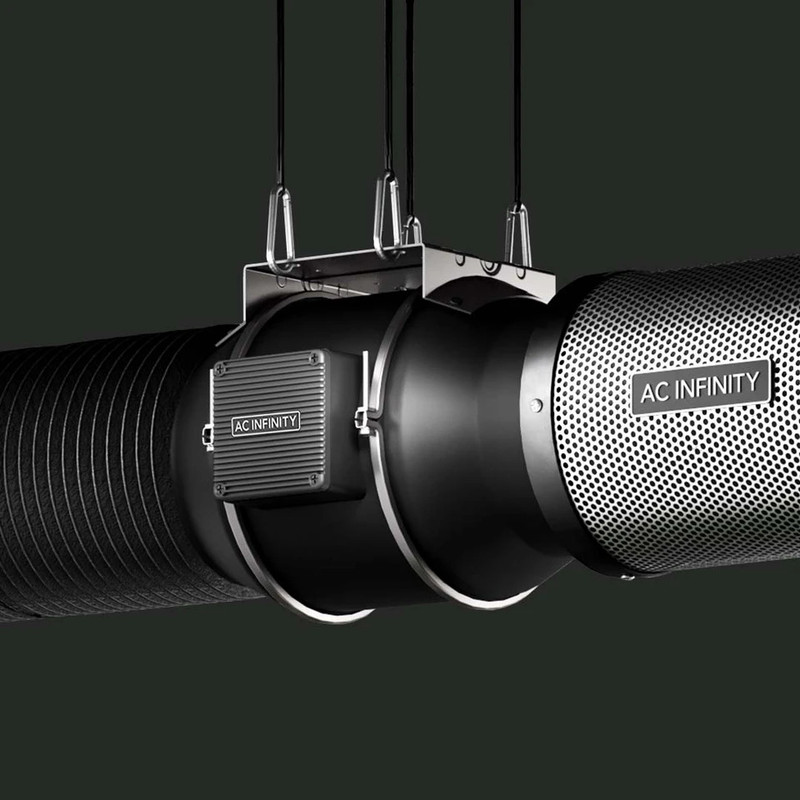
Ventilation Fans and Exhaust Fans: Creating The Best Airflow
Are your plants doing better than you are?
You're checking humidity before your texts. You know your grow tent temp better than the weather outside. You've casually dropped "VPD" into a conversation and nobody questioned it.
At some point, this stopped being a casual hobby and turned into a system you're maintaining every day.
That's usually when it clicks.
This isn't about lights anymore. It's about your ventilation fan. Your exhaust fan. The stuff running in the background that either keeps everything stable or quietly lets it fall apart.
Because no matter how dialed everything else is, bad airflow will undo it.
And suddenly, everything depends on air movement.
- Ventilation fans exchange stale air for fresh air and help keep the grow environment stable.
- Proper airflow helps manage heat, humidity, CO₂, odor, and stagnant air.
- More airflow is not always better. The goal is consistent, balanced air movement.
- Controllers and sensors allow ventilation to respond automatically as temperature and humidity change.
- CLOUDLINE A4, T4, T6, and T10 provide options for different grow sizes and airflow demands.
- Carbon filters depend on controlled airflow and negative pressure for effective odor management.
- A complete ventilation system should work together rather than requiring constant manual adjustment.
The Real MVP: Ventilation Fans
There's always that moment when you realize the problem isn't what you thought it was.
It's not nutrients. It's not your light. It's the air just sitting there, doing nothing, slowly turning your grow into a stagnant box.
That's where a ventilation fan comes in.
A ventilation fan pulls stale air out and replaces it with fresh air, usually through ducting and a filter.
It sounds simple, but it's the difference between a space that drifts out of control and one that stays stable without constant attention.
- Heat creeps up
- Humidity spikes
- Mold becomes a real risk
- Air quality drops
- Growth slows
- Temperature stabilizes
- Humidity becomes predictable
- Plants grow consistently
- You stop babysitting your setup
It's not flashy, but it's foundational.
Why Ventilation Fans Matter More Than People Think
Plants are constantly reacting, even when nothing looks like it's happening.
They're releasing moisture, taking in CO₂, and adjusting to tiny environmental shifts that add up over time. When air stops moving, all of that stacks against you.
This is where ventilation fans and exhaust fans start working together, whether you planned it that way or not.
The ventilation system manages the exchange of stale and fresh air.
The exhaust fan helps push hot, stale air out and keeps airflow moving in the right direction.
Consistent air movement helps prevent heat, humidity, and stale air from building.
When it's working, you don't notice it. When it's not, everything feels slightly off.
- Remove heat from grow lights
- Keep humidity from drifting
- Prevent mold and mildew
- Maintain fresh CO₂
- Support plant processes like transpiration
- Allow carbon filters to function properly
- Keep airflow controlled with negative pressure
Without it, your grow is basically guessing.
Ventilation Fans Are About Balance, Not Just Power
A lot of people try to brute-force their way through airflow problems.
Bigger fan, higher speed, hope it fixes things.
Sometimes it works for a minute. Most of the time it just creates a different problem.
Because airflow isn't about force. It's about balance.
- Heat builds
- Humidity spikes
- Air goes stale
- Plants get stressed
- Temperature swings too fast
- Humidity drops too hard
- Growth becomes inconsistent
What you actually want is consistency. The kind you don't have to think about every hour.
When Ventilation Starts Reacting for You
This is where things start to feel different.
Once you bring controllers and sensors into the mix, your ventilation fan stops being manual and starts reacting.
Fan speed adjusts as the grow environment gets warmer.
Airflow compensates as moisture conditions change.
That's when your grow starts feeling less like a chore and more like a system.
When Your Grow Stops Being a Setup and Becomes a System
There's a point where you get tired of chasing numbers.
Adjusting fan speed. Opening vents. Checking temps. Tweaking humidity.
It works, but it eats up your time.
That's when a complete system starts to make sense.
AC Infinity offers complete grow kits that tie everything together from the start.
Instead of piecing together a ventilation fan, exhaust fan, controller, and sensors, it's all designed to work as one environment.
- Inline fan systems connected to smart controllers
- Sensors tracking temperature and humidity in real time
- Automated adjustments without constant input
- Consistent exhaust fan systems performance
- Carbon filters that work with your airflow
You're not reacting anymore. You're setting conditions and letting the system hold them.
And once you experience that, it's hard to go back.
Choosing the Right CLOUDLINE Ventilation Fan
Most setups start small. A tent, a light, and a plan that gets more complicated once things start growing.
This is where a properly sized ventilation fan makes the biggest difference.
CLOUDLINE A4
Not every grow needs to start fully optimized. The CLOUDLINE A4 keeps things simple.
- Basic speed control
- Reliable airflow
- Quiet operation
- Works as a simple exhaust fan
CLOUDLINE T4
The CLOUDLINE T4 fits naturally into smaller grow tents where environmental control starts becoming more important.
- Handles carbon filters and ducting
- Runs quietly
- Adjusts based on temperature and humidity
- Keeps exhaust fan performance consistent
CLOUDLINE T6
As your grow expands, airflow needs change. More light, more space, and more resistance can make stepping up necessary.
The CLOUDLINE T6 helps maintain consistency as those demands increase.
- Keeps airflow stable under load
- Supports longer ducting
- Maintains steady exhaust performance
- Prevents environmental drift
CLOUDLINE T10
More tents. More equipment. More moving parts. At some point, your setup becomes a system.
The CLOUDLINE T10 is built for that level.
- Moves large volumes of air
- Handles complex ducting
- Maintains stable pressure
- Supports multi-tent setups
It's About Stability, Not Perfection
The goal isn't automatically choosing the largest ventilation fan. It's matching airflow to the needs of the environment so temperature, humidity, and exhaust performance remain consistent.
The Role of Exhaust Fans
Exhaust fans are part of the system, but not the whole thing.
Push warm, stale air out of the grow environment.
Help keep airflow moving in a controlled direction through the tent.
Keep the overall ventilation cycle moving consistently.
Ventilation fan is the system. Exhaust fan supports it.
Odor Control Is Really an Airflow Problem
Most odor issues are airflow issues.
A carbon filter can only work with the air moving through it. When airflow or pressure becomes unstable, odor control becomes less predictable.
Grow tent air is directed toward the exhaust system.
Odorous air passes through the filter as part of the ventilation path.
Controlled pressure helps keep odor from escaping through unintended openings.
- Weak airflow allows odors to bypass the intended path
- Unstable pressure can allow smell to leak out
- Controlled airflow allows the filter to do its job
Good airflow makes filters work.
Quiet Ventilation Fans Matter More Than You Think
Noise becomes a problem fast in shared spaces.
A ventilation system may run for long periods, so noise that seems minor during setup can become much more noticeable over time.
Better ventilation fans stay quiet even under load, making your grow easier to live with.
Better Airflow Changes Everything
Most growers try to fix problems by adding more.
More equipment. More power. More adjustments.
But usually, it comes down to airflow.
Move excess heat out before it continues building inside the grow environment.
Keep moisture from lingering and pushing conditions out of range.
Maintain airflow and pressure through the intended filtration path.
Create a more consistent environment for plant growth.
The Best Ventilation Systems Feel Simple
Good grow tent ventilation is about more than moving the biggest possible volume of air. Fan size, ducting, filtration, and the amount of air the space actually needs all determine whether the system creates useful, consistent airflow. From there, inline fans covers the equipment, required CFM for a grow tent helps with sizing, and grow tent ducting and carbon filters fill in the ducting and filtration side of the system.
You stop guessing at airflow and start maintaining a system that works.