


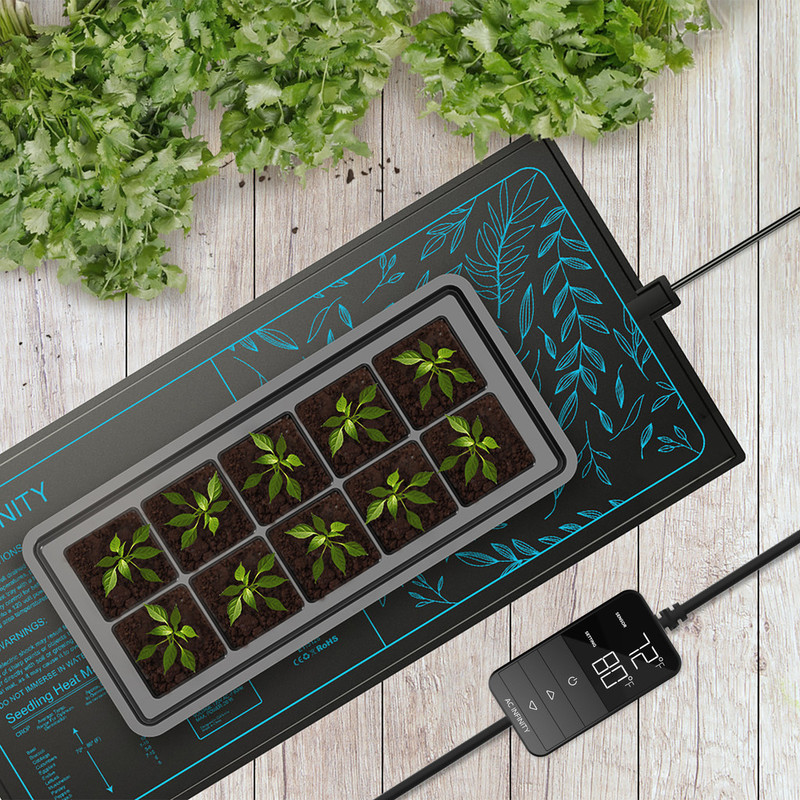
What Is a Seedling Heat Mat? Exploring Its Benefits
Starting seeds indoors is one of the best ways to get a head start on the growing season, but successful germination depends heavily on maintaining the right soil temperature.
Many vegetables, herbs, flowers, and tropical plants require warm soil temperatures before they'll sprout consistently. If the soil is too cool, seeds can remain dormant for weeks, germinate unevenly, or fail altogether.
That's where a seedling heat mat comes in.
A seedling heat mat is a low-wattage heating device designed to gently warm the soil beneath seed trays and propagation containers. Unlike a household heating pad, these mats provide consistent, even warmth that's specifically engineered for seed germination and early root development.
By maintaining the ideal root-zone temperature, heat mats help seeds germinate faster, improve germination rates, and produce stronger, healthier seedlings. Whether you're growing vegetables, herbs, flowers, houseplants, or cannabis, understanding how a seedling heat mat works can dramatically improve your success rate.
- Seedling heat mats warm the root zone instead of heating the entire room.
- Warm-season crops such as tomatoes, peppers, cucumbers, melons, and basil benefit most from supplemental bottom heat.
- Quality mats can raise soil temperature approximately 10 to 20°F above ambient conditions.
- A thermostat provides greater control and helps prevent overheating.
- Heat mats are intended primarily for germination and can usually be removed once most seedlings emerge.
- Humidity domes and heat mats can work together to create a stable propagation environment.
Why Soil Temperature Matters
Many new growers focus on air temperature, but soil temperature is often more important during germination.
Seeds absorb water before sprouting, activating enzymes that begin the germination process. Those enzymes work best within specific temperature ranges. If the soil is too cold, biological activity slows considerably.
Warm-season plants such as:
All germinate much faster in warm soil than in cool conditions. While room temperatures may seem comfortable, the potting mix inside a seed tray is often much cooler than the surrounding air, especially near windows during winter.
Warm the root zone, not the room
A seedling heat mat solves this problem by warming the root zone instead of heating the entire room. Most quality mats increase soil temperature approximately 10 to 20°F above ambient conditions, creating an ideal environment for rapid germination.
How Does a Seedling Heat Mat Work?
A seedling heat mat plugs into a standard wall outlet and produces gentle radiant heat underneath your propagation tray.
Modern heat mats use thin conductive heating films instead of traditional heating coils.
- Even heat distribution
- Reduced hot spots
- Lower energy consumption
- Consistent soil temperatures
- Improved safety
Many premium models, including the AC Infinity SUNCORE series, use far-infrared heating film that spreads heat uniformly across the entire surface while protecting delicate seedlings from overheating. Their waterproof multi-layer construction also makes them suitable for humid propagation environments.
Benefits of Using a Seedling Heat Mat
Faster Germination
Warm soil encourages faster metabolic activity inside the seed. Instead of waiting two weeks for sprouts, many warm-season crops emerge in just a few days under optimal conditions.
Higher Germination Rates
Not every seed in a packet germinates naturally. Providing consistent warmth improves overall germination percentages by giving every seed similar growing conditions.
More Uniform Seedlings
Uneven germination makes indoor gardening difficult. Heat mats encourage seedlings to emerge around the same time, simplifying watering, lighting, transplanting, and fertilization.
Stronger Root Development
Root systems begin developing before leaves emerge. Keeping the root zone warm promotes healthy early growth, allowing seedlings to establish themselves faster.
Earlier Harvests
Starting seeds indoors several weeks before outdoor planting lets gardeners extend their growing season. When combined with a heat mat, seedlings often reach transplant size sooner, giving growers an even greater head start.
Which Plants Benefit Most?
Seedling heat mats work especially well for crops that naturally germinate in warm climates.
Tomatoes, bell peppers, hot peppers, eggplants, cucumbers, squash, melons, basil, okra, cannabis, tropical houseplants, and many flowering annuals can benefit from supplemental warmth.
Lettuce, spinach, kale, and broccoli generally don't require supplemental heat and may germinate better in cooler soil temperatures.
More heat isn't automatically better. The goal is to provide the root-zone temperature that matches the crop you're germinating.
Do You Need a Thermostat?
While basic heat mats work well on their own, adding a digital thermostat gives growers much greater control.
- Monitor soil temperature
- Automatically turn heating on and off
- Prevent overheating
- Match different crop requirements
- Eliminate guesswork
For growers starting multiple varieties with different preferred germination temperatures, a thermostat is one of the best upgrades available.
The AC Infinity SUNCORE H-Series includes a digital controller capable of displaying real-time mat temperature while allowing precise adjustments from 32°F to 122°F.
How Long Should You Leave a Heat Mat On?
A common mistake is leaving the heat mat running throughout the entire seedling stage. Heat mats are intended primarily for germination.
- Start after sowingTurn on the heat mat immediately after sowing seeds.
- Maintain consistent warmthKeep it running continuously until seedlings emerge.
- Remove the heatRemove or unplug the mat once most seeds have sprouted.
- Continue under proper lightingMove the focus from germination temperature to providing the young seedlings with appropriate lighting and growing conditions.
Don't overheat established seedlings
Leaving seedlings on excessive bottom heat after germination may produce weak, leggy plants.
Should You Use a Humidity Dome?
Absolutely.
Humidity domes complement seedling heat mats perfectly.
Bottom heat helps maintain a more consistent root-zone environment.
The dome helps maintain the humid conditions often preferred during germination.
Enclosing the propagation tray helps prevent the growing media from drying as quickly.
Together, warmth and moisture create favorable conditions for seed germination.
Once seedlings emerge, remove the humidity dome to improve airflow and reduce the risk of fungal diseases.
Can a Seedling Heat Mat Burn Plants?
Quality seedling heat mats are designed specifically to avoid this problem.
Unlike heating pads intended for medical use, propagation mats provide gentle warmth rather than high heat.
- Even heating technology
- Waterproof construction
- Low wattage
- Temperature regulation
- Durable insulation
Adding a thermostat further reduces any possibility of overheating.
Choosing the Right Seedling Heat Mat
Look for features such as:
- Waterproof construction
- Even heat distribution
- Flexible design
- Durable PVC materials
- UL or MET safety certifications
- Optional digital thermostat
- Correct size for your propagation trays
A larger mat isn't always better. Choose a size that closely matches your seed tray to maximize efficiency.
AC Infinity SUNCORE Seedling Heat Mats
The AC Infinity SUNCORE lineup offers several heat mat options for growers ranging from hobby gardeners to commercial propagation operations.
Built with far-infrared heating technology, waterproof IP67-rated construction, and durable multi-layer PVC, these mats provide even warmth for improved germination while remaining easy to clean and store. Selected models also include integrated digital temperature controllers for precise heat management.
SUNCORE Comparison Table
| Model | Size | Controller | Best For |
|---|---|---|---|
| SUNCORE A1 | 3" × 20" | No | Windowsills and small propagation trays |
| SUNCORE T1 | 3" × 20" | Digital Thermostat | Precise temperature control in compact spaces |
| SUNCORE S3 | 10" × 20.75" | Heat Controller | Standard 1020 propagation trays |
| SUNCORE A3X2 | Dual 10" × 20.75" | Heat Controller | Growing multiple trays simultaneously |
| SUNCORE H3 | 10" × 20.75" | Digital Heat Controller | Home gardeners and indoor growers |
| SUNCORE A5 | 20" × 20.75" | No | Larger propagation setups |
| SUNCORE H5 | 20" × 20.75" | Digital Heat Controller | Medium-scale propagation |
| SUNCORE A7 | 48" × 20.75" | No | Commercial propagation benches |
| SUNCORE H7 | 48" × 20.75" | Digital Heat Controller | Professional growers and greenhouse propagation |
Frequently Asked Questions
Do seedling heat mats use a lot of electricity?
No. Most seedling heat mats consume very little power compared to space heaters, making them inexpensive to operate throughout the germination period.
Can you leave a heat mat on overnight?
Yes. Seed germination requires consistent temperatures, so heat mats are typically left running 24 hours a day until seedlings emerge.
Can I put pots directly on the heat mat?
Yes. Seed trays, nursery pots, and propagation trays are designed to sit directly on top of the mat.
Are heat mats waterproof?
Quality propagation mats should be waterproof or water-resistant to withstand regular watering and humid environments. AC Infinity SUNCORE mats feature an IP67 waterproof design for durability and easy cleaning.
Can I use a regular heating pad instead?
No. Medical heating pads and electric blankets become much hotter than propagation mats and aren't designed for wet growing environments. Using one may damage seedlings and create safety risks.
What temperature should seedlings be?
The ideal germination temperature depends on the crop, but many warm-season vegetables germinate best between 70°F and 85°F. A heat mat with a thermostat makes it easy to maintain these conditions.
Give Your Seeds a Stronger Start
A seedling heat mat is one of the simplest yet most effective tools for improving seed germination. By gently warming the root zone, it helps seeds sprout faster, increases germination success, and creates stronger, more uniform seedlings.
Successful propagation starts with creating stable conditions around the seed and root zone.
Whether you're starting vegetables for the garden, propagating herbs, growing ornamental flowers, or cultivating indoor plants, maintaining consistent soil temperatures can dramatically improve your results.
For growers looking for dependable performance, the AC Infinity SUNCORE series offers options ranging from compact windowsill mats to large commercial propagation solutions, with waterproof construction, far-infrared heating technology, and optional digital controllers for precise temperature management.