Carbon Filters for Grow Tents: How they Work and How to Choose the Right One
A practical guide to odor control, filter sizing, CFM matching, and refillable carbon filtration.
- Carbon filters use activated carbon to adsorb odor compounds and gases from the exhaust airstream.
- The filter should match your inline fan's duct diameter and be rated for at least the airflow you intend to move.
- Standard, extra-long, and refillable filters provide different options for carbon capacity, airflow, and long-term maintenance.
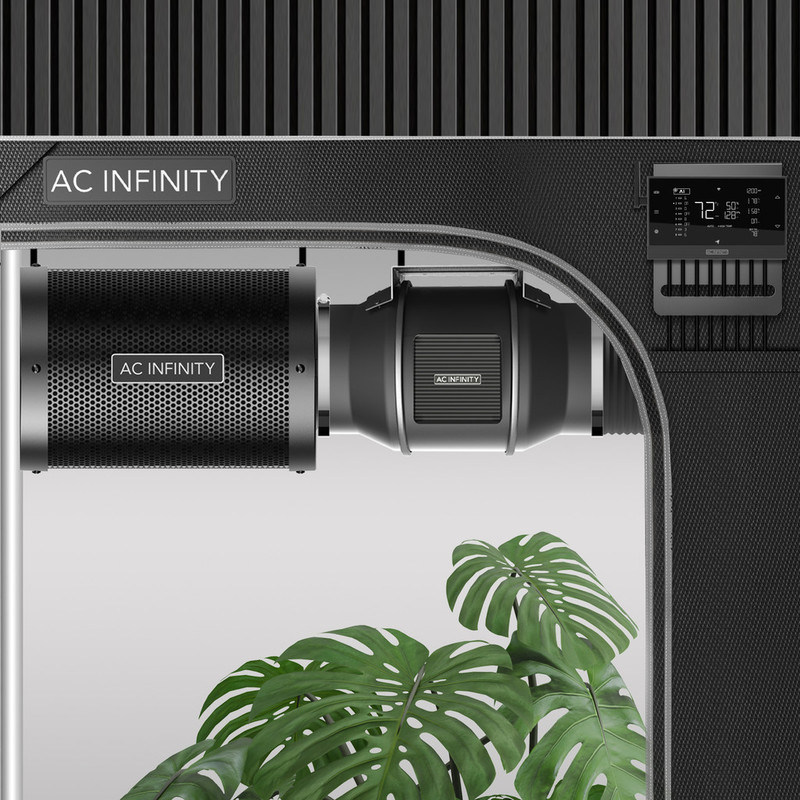
- Carbon filtration works as part of the complete ventilation system, alongside the inline fan, ducting, circulation, and environmental controls.
Carbon filters are an important part of that system because activated carbon is designed to adsorb odor compounds and other gases before exhaust air leaves the grow space. When a carbon filter is correctly sized and paired with an inline fan, it can provide consistent odor control while allowing the ventilation system to keep moving air through the tent.
For indoor growers, the goal is not simply moving air. It is creating a system where airflow, temperature, humidity, and odor can be managed together. A properly selected carbon filter is a key part of that system.
What Are Carbon Filters and How Do They Work?
Carbon filters are air-filtration devices that use activated carbon to adsorb unwanted odor compounds and gases from an airstream. Activated carbon has a highly porous structure with a large surface area. As air passes through the carbon bed, odor-causing compounds interact with and become adsorbed onto the carbon.
Carbon filtration is different from particulate filtration
A grow-tent carbon filter is primarily an odor and gas-control device, not a HEPA-style particulate filter. Its activated carbon is there to target odor compounds rather than dust, pollen, or other airborne particles.
In a typical grow-tent ventilation setup, the process is straightforward:
- Pull air from the grow tentAn inline fan pulls warm, humid air from the grow tent.
- Move air through the filterThe exhaust airstream passes through the carbon filter.
- Adsorb odor compoundsActivated carbon adsorbs odor compounds from the airstream.
- Exhaust filtered airFiltered exhaust air is routed outside the grow space.
This makes carbon filtration especially valuable when growers want reliable odor management without relying on air fresheners or products that simply mask smells. A carbon filter works as part of the exhaust system itself.
Why Carbon Filters Matter for Grow Tents
An indoor grow tent is a controlled environment. Lighting creates heat, plants release moisture, fans move air, and aromas can become stronger as the grow progresses. Without adequate exhaust and filtration, those odors can move beyond the growing area.
A carbon filter becomes the odor-control stage of the ventilation system. When installed correctly, it helps reduce strong plant aromas before the exhaust air leaves the tent.
Odor Control
Helps reduce strong plant aromas before exhaust air leaves the grow space.
Integrated Filtration
Filters the exhaust stream as part of the ventilation system rather than covering odors with fragrance.
Ventilation Compatibility
Works with inline fans to move air through the carbon bed while maintaining useful airflow.
Environmental Management
Supports a more controlled grow-tent environment when combined with proper exhaust and circulation.
A carbon filter does not replace ventilation. It works with the inline fan and ducting to create a complete exhaust system.
How Carbon Filters Fit Into a Complete Grow Tent Ventilation System
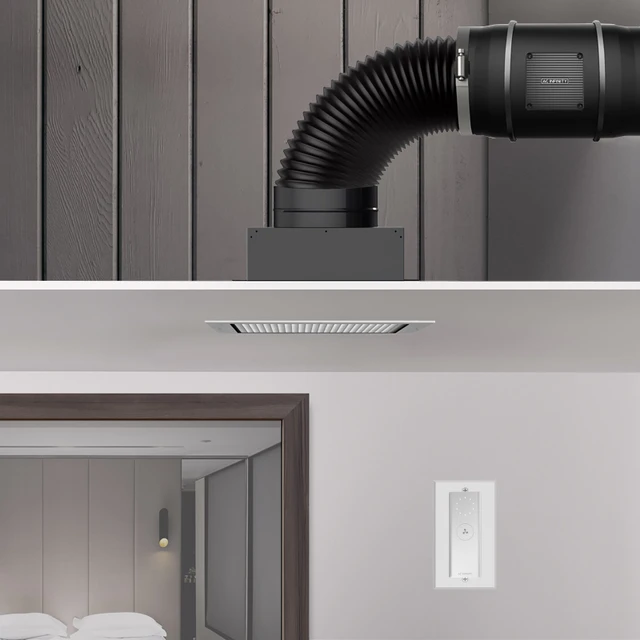
A carbon filter performs best when it is treated as one component of a complete ventilation path.
Air passes through the activated carbon bed for odor control.
The fan creates the airflow needed to pull air through the filter.
Ducting carries the filtered exhaust air away from the grow space.
Filtered air is routed to the desired exhaust location.
The system can be configured differently depending on the application, but the basic requirement remains the same: air must pass through the activated carbon before it is exhausted from the grow space.
Proper ducting also matters. Long duct runs, sharp bends, restrictive accessories, and other components can reduce the airflow the fan actually delivers. That is why choosing a filter based only on the fan's advertised maximum CFM is not enough. The complete system needs to be considered.
How to Choose the Right Carbon Filter Size
Use the chart below to compare AC Infinity carbon filter sizes, styles, and recommended ventilation applications.
| Product | Size | Type | Best For |
|---|---|---|---|
| Duct Carbon Filter 4" with Australian Charcoal | 4" | Standard | 4" inline fan systems |
| Duct Carbon Filter 4" Extra Long with Australian Charcoal | 4" | Extra Long | 4" systems needing additional carbon capacity |
| Duct Carbon Filter 6" with Australian Charcoal | 6" | Standard | 6" inline fan systems |
| Duct Carbon Filter 6" Extra Long with Australian Charcoal | 6" | Extra Long | 6" systems needing additional carbon capacity |
| Duct Carbon Filter 8" with Australian Charcoal | 8" | Standard | 8" inline fan systems |
| Duct Carbon Filter 8" Extra Long with Australian Charcoal | 8" | Extra Long | 8" systems needing additional carbon capacity |
| Duct Carbon Filter 10" with Australian Charcoal | 10" | Standard | 10" inline fan systems |
| Duct Carbon Filter 12" with Australian Charcoal | 12" | Standard | 12" inline fan systems and larger ventilation setups |
| Refillable Carbon Filter Kit 4" | 4" | Refillable | Reusable odor control for 4" systems |
| Refillable Carbon Filter Kit 6" | 6" | Refillable | Reusable odor control for 6" systems |
| Refillable Carbon Filter Kit 8" | 8" | Refillable | Reusable odor control for 8" systems |
From there, look at the filter's airflow rating and compare it with the amount of airflow your fan needs to deliver.
- Identify your duct sizeIdentify your inline fan's duct size.
- Determine your intended airflowDetermine the airflow you actually want from the fan, not just its maximum advertised CFM.
- Match the diameterChoose a carbon filter with the same duct diameter.
- Check the airflow ratingMake sure the filter's rated airflow is at or above the fan's intended operating airflow.
- Account for restrictionsConsider the rest of the ventilation system, including duct length, bends, and other restrictions.
For example, AC Infinity's standard carbon filters are currently rated at up to 210 CFM for 4-inch models, 410 CFM for 6-inch models, and 770 CFM for 8-inch models. Extra-long versions increase those ratings to 300 CFM, 520 CFM, and 930 CFM respectively. These ratings provide a useful reference when matching a filter to an inline fan.
If your fan is capable of more airflow than the filter is rated to handle, the filter can become a limiting component. In that situation, selecting a larger-capacity filter or an extra-long model can make more sense than simply running the fan harder.
Bigger is not automatically better
A filter should fit the physical space and ventilation system while providing enough carbon capacity and airflow capability for the application.
Filter Size and CFM: A Simple Matching Guide
Use the following as a quick reference when evaluating AC Infinity carbon-filter options:
| System Size | Standard Filter | Extra-Long Filter | Refillable Filter |
|---|---|---|---|
| 4-Inch Systems | Up to 210 CFM | Up to 300 CFM | Up to 210 CFM |
| 6-Inch Systems | Up to 410 CFM | Up to 520 CFM | Up to 410 CFM |
| 8-Inch Systems | Up to 770 CFM | Up to 930 CFM | Up to 770 CFM |
Carbon Quality Matters
Once size and airflow are addressed, the quality and amount of activated carbon become important. AC Infinity carbon filters use premium Australian virgin charcoal rated at 1200+ IAV, with RC412 microporosity. The carbon bed is designed to provide a large adsorption surface while maintaining airflow through the filter.
Carbon Quality
AC Infinity carbon filters use premium Australian virgin charcoal rated at 1200+ IAV, with RC412 microporosity.
Carbon Capacity
A larger carbon bed can provide more material for adsorption, while an extra-long filter can increase carbon capacity without changing the duct diameter.
This is one reason it is useful to look beyond the filter's flange size. Two filters can have the same duct diameter but different dimensions, carbon-bed capacity, and airflow ratings.
Refillable Carbon Filters: A More Sustainable Option
For growers who want to reduce the need to replace an entire filter, AC Infinity also offers refillable carbon filters. These models use a patented design that allows the activated carbon to be replaced instead of disposing of the complete filter assembly.
Provides a straightforward filtration solution with the complete filter replaced once the carbon reaches the end of its useful service life.
Uses a reusable housing that can be opened and reloaded with fresh activated carbon for continued use across multiple grow cycles.
The refillable line is available in 4-, 6-, and 8-inch sizes and includes an extra charcoal refill with each kit. AC Infinity states that the included refill is intended to provide the filtration capacity of two standard filters while costing less, and additional activated-carbon refills are available separately.
The refillable design is especially useful for growers who expect to run their ventilation system through multiple grow cycles. Instead of buying a completely new carbon filter once the carbon is spent, the filter housing can be opened and reloaded with fresh activated carbon.
- Removable twist-off flanges
- Funnel and scoop for loading fresh carbon
- Washable prefilter cloth
- Reversible flanges to help extend carbon-bed life
- Additional activated-carbon refills available separately
This gives growers another option: choose a conventional carbon filter for simple replacement, or choose a refillable model when long-term reuse, reduced waste, and replacement-carbon availability are priorities.
When Should You Replace the Carbon?
Activated carbon eventually becomes saturated and less effective. Rather than relying only on a fixed calendar schedule, odor performance is a useful indicator of when the carbon needs attention.
The amount of air moving through the filter can influence service life.
High humidity can reduce adsorption performance because moisture competes with odor molecules.
The amount of odor passing through the system affects how quickly the carbon becomes saturated.
How frequently the ventilation system operates also affects carbon lifespan.
For refillable models, the advantage is that you can replace the spent carbon without replacing the entire filter housing. AC Infinity's refillable systems are designed around this approach, with additional charcoal sold separately in multiple sizes.
Common Carbon Filter Mistakes
Even a high-quality carbon filter can underperform if the ventilation system is poorly matched.
- Using the wrong duct size: A filter should match the diameter of the inline fan and ducting.
- Choosing a filter with too low an airflow rating: The filter should be rated for at least the airflow you intend to move.
- Sizing from fan maximum CFM alone: The fan's real operating airflow can be lower once static pressure and duct restrictions are introduced.
- Using restrictive or poorly sealed ducting: Leaks and unnecessary bends can reduce effective airflow.
- Installing the filter incorrectly: Air needs to pass through the carbon bed for the filter to perform its intended function.
- Ignoring humidity: Excessive moisture can reduce carbon adsorption performance.
- Waiting until odor control has already failed: Monitor performance and replace or refill the carbon when odor compounds begin passing through.
Good filtration is not just about buying the most expensive filter. It is about matching the filter to the rest of the ventilation system.
AC Infinity Carbon Filters for Grow Tents
AC Infinity carbon filters are designed to integrate with inline fan systems used in grow tents and indoor growing environments. The lineup includes standard, extra-long, and refillable options in multiple duct sizes.
A straightforward solution for growers who want a conventional carbon filter.
Increases carbon capacity and airflow capability while retaining the same duct diameter.
Adds a reusable housing and replaceable activated carbon for growers who want a longer-term filtration solution.
Across the lineup, AC Infinity uses premium Australian activated carbon rated at 1200+ IAV and designs the filters around high airflow through the carbon bed. The filters also use durable metal construction and prefilter cloths to help protect the carbon from dust and debris.
For growers building a complete system, the key is to match the filter to the inline fan, duct size, desired airflow, and available physical space rather than selecting based on size alone.
Carbon Filters and Grow-Tent Climate Control
Odor control is the most obvious reason to use a carbon filter, but the filter also becomes part of the broader climate-control system.
An exhaust fan removes warm and humid air from the grow tent. The carbon filter sits in that exhaust path so the air is treated for odor before it leaves the growing environment. When paired with appropriate circulation, environmental monitoring, and fan controls, the result is a more complete approach to managing the grow space.
The key is balance
A filter that is too restrictive for the fan can reduce useful airflow. A filter that is too small for the application may not provide enough carbon capacity. A properly matched filter gives the ventilation system the filtration it needs without unnecessarily compromising airflow.
Choose the Filter as Part of the System
Carbon filters are one of the most useful tools for managing odor in a grow tent, but choosing the right one requires more than looking at the word "carbon" on the product label.
Start with duct diameter, then match the filter's airflow capability and carbon capacity to the needs of the complete ventilation system.
Consider the airflow your inline fan needs to deliver, compare that number with the filter's rated CFM, and account for ducting and other system restrictions. If you need more carbon capacity, an extra-long filter can be a practical upgrade. If you want to avoid replacing the entire filter housing, a refillable carbon filter offers another long-term option.